Sidney Claire Meyer

The Intimacy of Analogue Sound

Sidney Claire Meyer from Emil Berliner Studios oversees the production of the vinyl editions for Berliner Philharmoniker Recordings. The mastering & disc cutting engineer attributes the comeback of the record to a more intimate relationship with music that the analogue medium makes possible. In this interview, she discusses the challenges of mixing, mastering and cutting LPs to the highest standards demanded by Berliner Philharmoniker state-of-the-art recordings – as well as market developments in the recording industry.


You oversee the production of the vinyl editions for Berliner Philharmoniker Recordings. What steps do you follow once you receive the recordings from us?

Once I’ve received the recordings, I begin by importing them into my digital audio workstation. There I gain an overview of the running times, number and sequence of pieces, dynamics, intensity, instrumentation/arrangement and the overall sonic aesthetic. I then try to assess which passages or tracks might be particularly challenging, as with the vinyl record – an analogue medium – specific considerations must be taken into account.

If the programme is cut too quietly, groove noise such as surface noise or crackles becomes more prominent, compromising what’s known as the signal-to-noise ratio. However, some instruments tend to produce troublesome distortion on vinyl even at moderate levels. This includes brass instruments. For the Christmas record Frohe Weihnachten!, it was crucial to find the ‘sweet spot’, so that the musical signal stood out clearly from the surface noise, whilst remaining moderate enough that listening pleasure wasn’t diminished by distortion.


Sidney Claire Meyer

Once I have an idea of how the transfer can be realised technically and sonically, a test cutting on lacquer follows. Lacquer discs can be played back just like an ordinary vinyl record, so I can directly assess how the result will sound later on. During this process, I cut the grooves of the selected passages at precisely the position on the disc where they’ll ultimately appear.

If the test cutting sounds as I’d imagined, I then cut the vinyl master for industrial production. If, however, I discover that something doesn’t sound as intended or problems arise, I analyse the cause and adjust the transfer parameters accordingly. But with acoustic music, there are usually no nasty surprises.

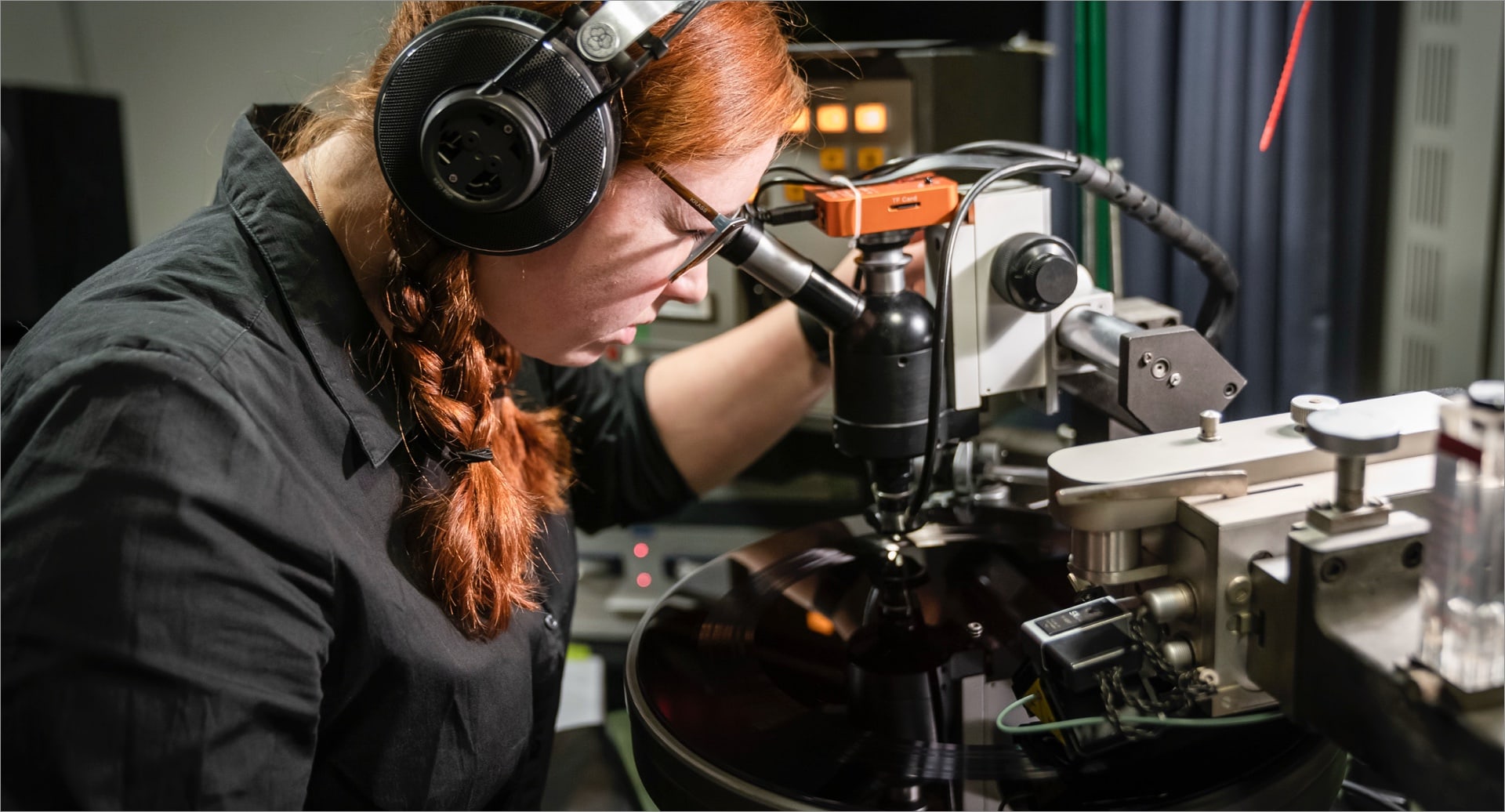
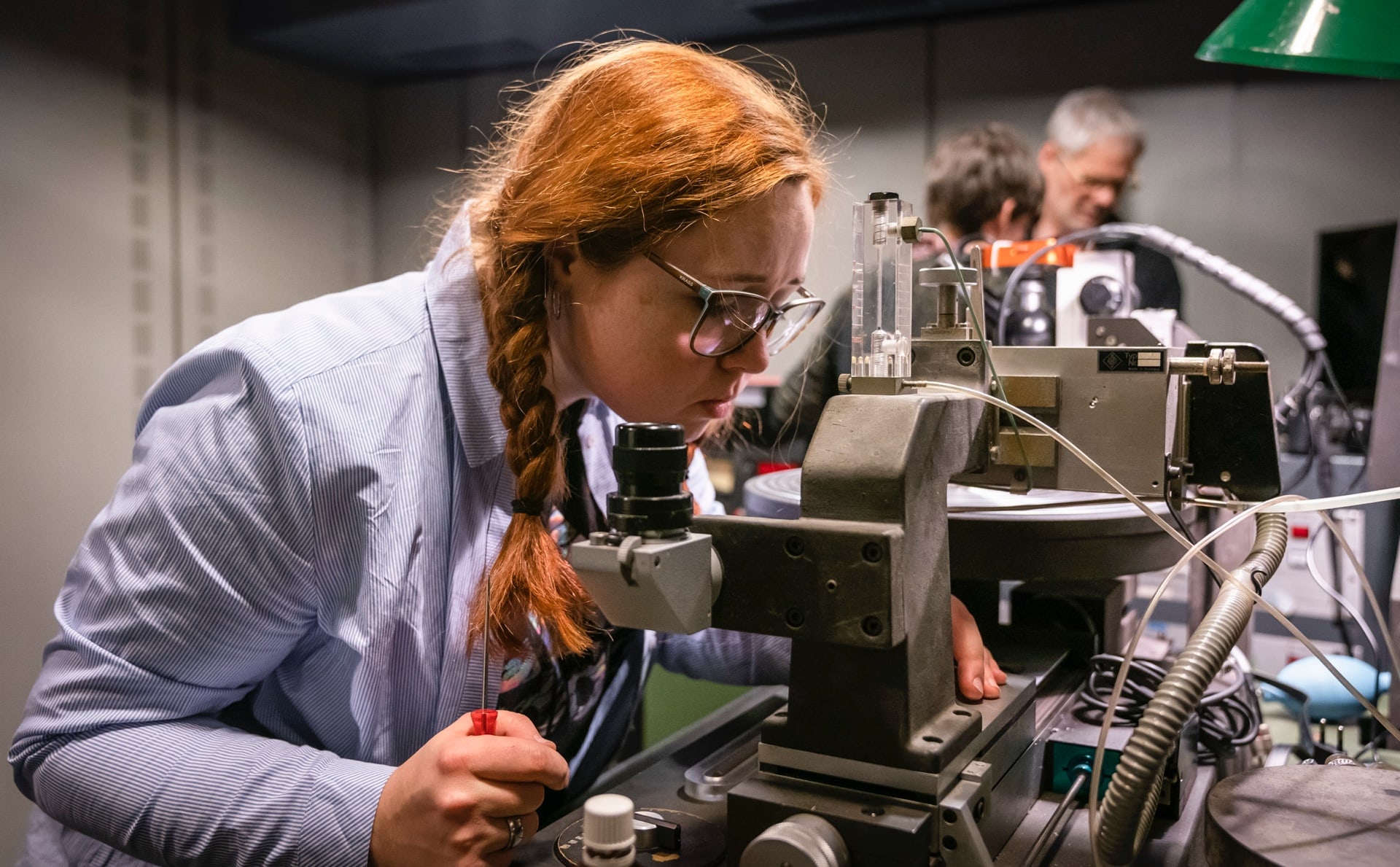
This master must not be played back again, because unlike the test cutting, one cannot accept any wear on the master. Instead, I inspect it optically under the microscope to ensure the grooves are the correct depth, that they’re cleanly cut, that they don’t intersect one another, and so forth.

If everything looks flawless, I carefully package the lacquer discs and send them to the pressing plant as quickly as possible. Swift processing is crucial for the quality of the product, as lacquer discs are sensitive to both time and temperature. After cutting, the lacquer’s surface tension changes, which can cause the groove shapes to alter minimally once more. To prevent this, the disc must be transported and stored at a low temperature. At the pressing plant, a metal master is produced through electroplating – only then is the malleable form made stable and durable.


 

How long have you been working in the field of vinyl production, and what fascinates you about it?

I’ve been working at Emil Berliner Studios since 2017, when I began as an intern. While interning I developed a passion for everything to do with analogue technology, and in particular for the production of vinyl records. My boss Rainer Maillard sensed this and was determined to give me the opportunity to learn from one of the most experienced engineers in the entire industry, Kevin Gray. The company sent me to Los Angeles for several weeks in 2018 to work with him.

It was unique in every respect, as Kevin Gray runs a one-man operation and doesn’t actually offer internships. I spent a great deal of time in his studio, learning his mastering philosophy, and familiarising myself with his cutting lathe (a Neumann VMS 66). There are even a few records from that period that bear both our initials in the run-out groove.

I’ve been employed at Emil Berliner Studios as an engineer since 2018 and have been cutting vinyl records daily ever since. It is never boring! Despite one’s experience, you begin each project from scratch, as you can never predict exactly how a recording will translate to vinyl. This aspect continues to fascinate me in my profession: no project resembles another, just as every recording is unique. For digital formats it makes no difference whether the content is speech, chamber music or heavy metal. But for vinyl, even small differences in the production like microphone placement and mixing can have significant consequences.


Sidney Claire Meyer

When you think about it, it’s quite extraordinary that the principle works at all: we’re cutting a groove that’s only about 40 micrometres wide into a surface. Within that groove are the most delicate modulations – some so fine we can’t even see them under a microscope. And yet all the frequency and phase information is encoded in there, for two channels no less. Later, we can trace that same groove and get a sonic result that, ideally, comes so close to the original that only trained ears can tell the difference.


Since 2023, vinyl has been outselling CDs again in the USA – how do you explain this shift? Do you think we’ll see the same trend in Europe?

Yes, I think we’re seeing the same trend in Germany. I can see it not just in our ledgers at Emil Berliner Studios, but also in the annual report published by the Bundesverband Musikindustrie (German Music Industry Association) – Musikindustrie in Zahlen (The Music Industry in Numbers). They have some really clear graphics showing that vinyl sales revenue has been climbing steadily for several years now, whilst CD sales have been dropping sharply since the mp3 came along. What’s particularly interesting is that the revenue from CDs and vinyl is gradually reaching similar levels. If this continues, vinyl could soon be bringing in more revenue than CDs.

I believe this trend is strongly connected to our present age, in which artificial intelligence is omnipresent and digital content is available in infinite quantities at any time, so that many people yearn for something real and authentic. The vinyl record offers precisely that: a physical medium that captivates both visually and tactilely. One holds a large, beautiful cover in one’s hands, perhaps an elaborately designed booklet in the same format, and a substantial vinyl disc. One can even see and touch the music in the form of grooves.

The listening experience itself is different too. You listen to a vinyl record consciously – you place it on the turntable, turn it over, take your time with it. That creates a much more intimate relationship with the medium, and with the music. I’m convinced you engage with the content far more consciously and appreciatively than when a streaming service is running on autoplay in the background all day. A lot of people – particularly younger listeners – are rediscovering this for themselves. They’re realising how wonderful it feels to actually hold a physical record in your hands, to own something tangible that connects you with your favourite artists.


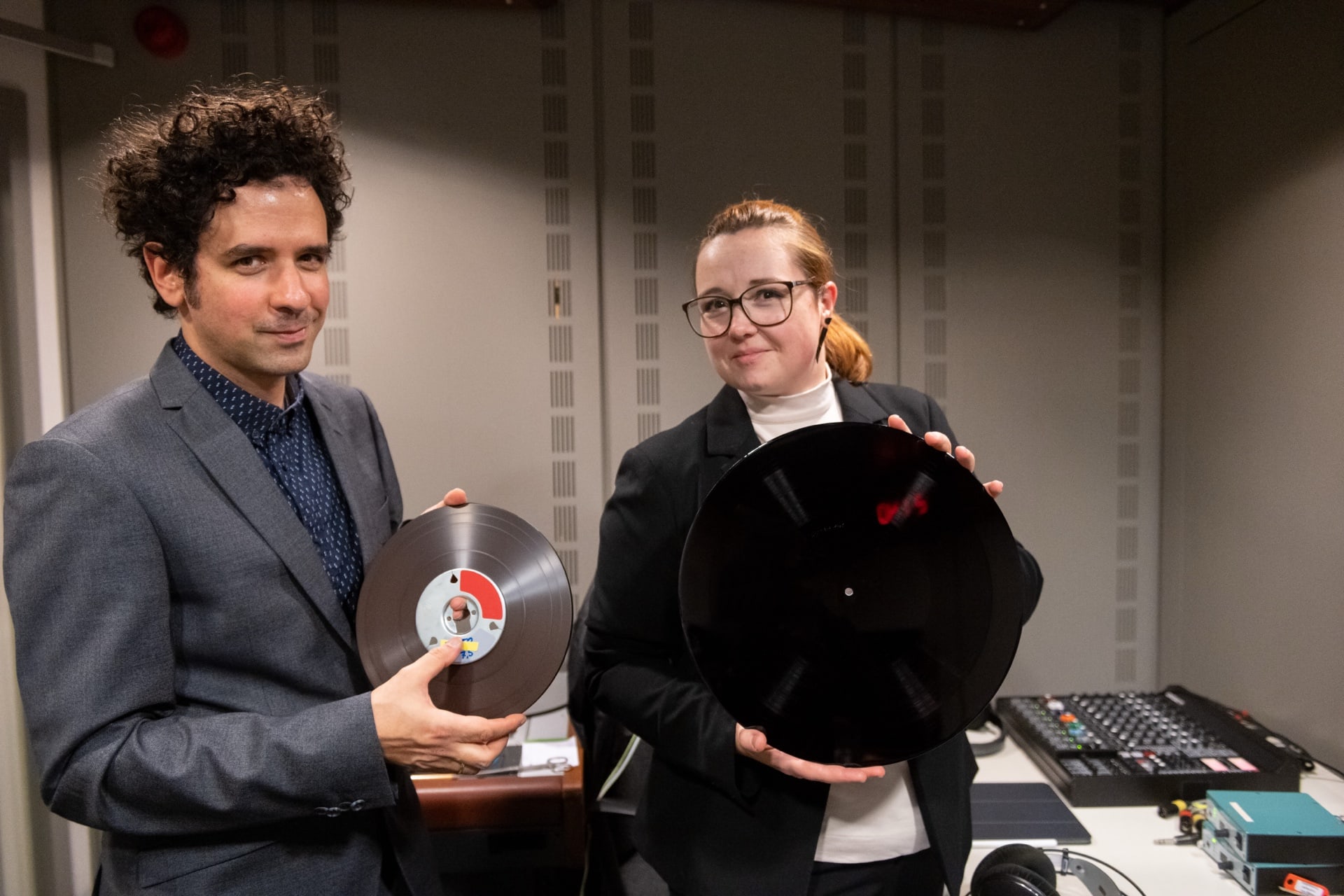
Sidney Claire Meyer with sound engineer Guy Sternberg
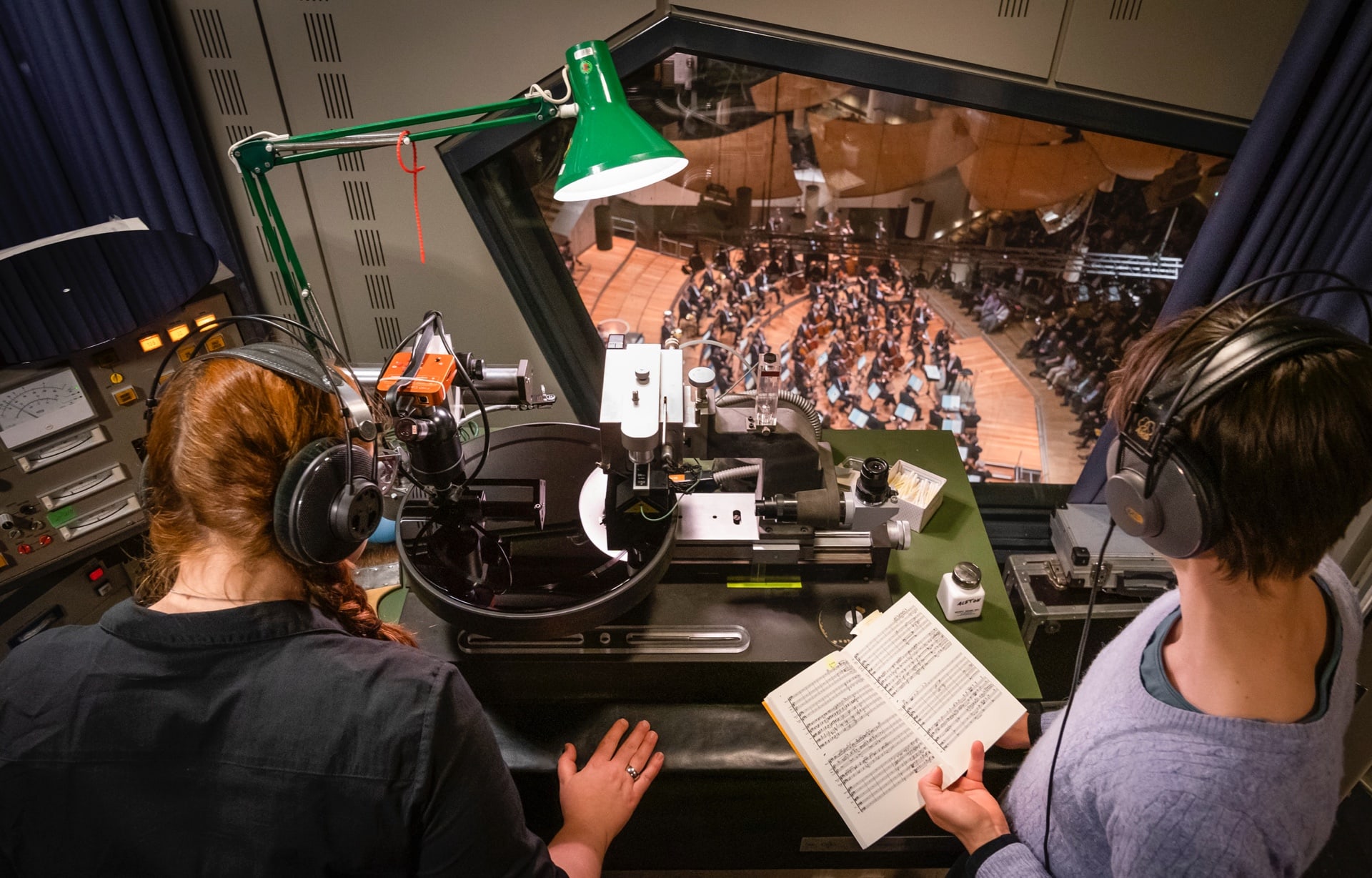
Sidney Claire Meyer with sound engineer Guy Sternberg during a direct-to-disc recording of a Berliner Philharmoniker concert